
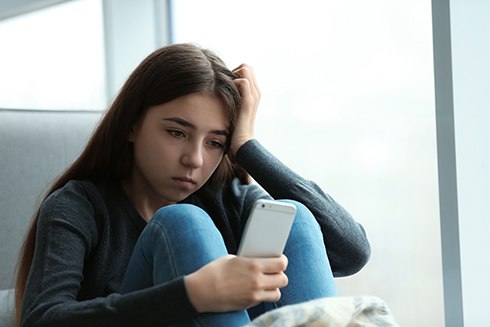

The signs of cyberbullying aren’t always obvious. Teens often keep what’s happening to them hidden due to fear or shame, or because they don’t want their devices taken away.
If a teen is being bullied online, from the outside in, it may not look like someone is tearing them down. They might continue to show up to school, say “I’m fine” when you ask how they’re doing in sessions, or even laugh it off if they mention something that was said.
Asking for help or admitting the truth of what’s happening might feel too overwhelming. They might even think they’re being overly dramatic. But the truth is that cyberbullying can have serious effects on their emotional and physical health. And without intervention, these effects could impact their long-term well-being.
This blog guides mental health professionals through what cyberbullying is, as well as what the warning signs are, to promote avenues for appropriate intervention and support.
What Is Cyberbullying?
Cyberbullying (or cyber bullying) can be difficult to detect as a parent. Plus, there are many types of cyberbullying, as it can occur via texts, group chats, social media posts, gaming chat, photo sharing apps, and fake/untraceable accounts.
So, evidently, there are countless ways for people to start online bullying. And, once it’s started, things can spiral out of a teen’s control, quickly becoming overwhelming.
In the most recent 2023 CDC reports:
- 77.0% of students reported using social media “almost constantly.”
- 17.0% of frequent social media users reported being electronically bullied at some point in the last year.[1]
Examples of cyberbullying include nasty messages, rumors or threats sent digitally, embarrassing social media posts, fake profiles, screenshots, being left out of group chats, or posting others’ private information.
Bullying online can be extremely difficult for teens to cope with because it doesn’t always stop when the school day is over. The constant access to devices can make teens feel like there is no escape, like they are being watched or are unsafe even when they are not in the presence of the person bullying them.[2][3]
Why Do People Cyberbully?
You might ask yourself why people cyberbully. Some teens bully online to feel socially powerful, to seek attention, to fit in with a group, to retaliate, or to prevent being targeted next. Plus, some bullies might not realize how hurtful they are being because they cannot see the other person’s face or reaction right away. This isn’t an excuse, but it may help parents see how cyber cruelty can become so rampant in teen social groups.[4]
Signs a Teen May Be Going Through Online Bullying
Each teen is unique, so they may deal with cyberbullying in their own way. However, the following are some common signs they may be being bullied online. Some of these signs might be more evident to parents, as they are the ones in closest proximity to teens. However, you may be able to observe them during sessions or question parents about whether a teen exhibits them at home.
1. They Become Protective or Panicked Around Their Phone
If a teen is being cyberbullied, they may suddenly behave differently when they receive a text or notification.
They may not necessarily be trying to hide something. It’s just that they might be trying to contain something that feels out of their control. For example, they may constantly check their phone because they’re worried about what others are posting. Alternatively, a teen may also avoid their phone because they don’t want to see another notification, screenshot, or comment.
Parents may be able to give more information about whether a teen who used to be chill about technology and now jumps or becomes secretive around their devices.
2. Their Mood Changes After Being Online
Many kids describe cyberbullying as being like an emotional rollercoaster. They may appear happy and calm before using the computer, gaming, or texting. Then they suddenly become snappy, quiet, tearful, angry, numb, or withdrawn after spending time online.
Studies have found connections between cyberbullying involvement and depression, anxiety, and emotional distress.[2][5][3] A teen may not experience every single one of these symptoms, but dramatic or inconsistent emotional changes may be a sign that something is up.
You could consider asking a teen or their family questions about mood changes after using certain programs, group chats, or online interactions.
 3. They Start Pulling Away From Friends or Activities
If a teen stops wanting to go to activities they used to enjoy, avoids group hangouts, or makes excuses like “I don’t feel like seeing anyone,” then something deeper may be going on.
Teens may feel more self-conscious, embarrassed, or judged due to cyberbullying. They may even feel they can’t trust their friends to keep things private. This may especially be the case if everyone talks to everyone else online.[3]
A teen may also avoid social situations to avoid being exposed to more opportunities for bullying. So it’s worth noticing if they suddenly quit friend groups, sports teams, clubs, or social hobbies. You can dig a little deeper into these patterns to determine if there has been a shift in their lifestyle.
4. Their Sleep Starts to Change
Cyberbullying can make it hard for a teen’s nervous system to calm down. After all, a teen’s phone may feel like both the enemy and their lifeline. So they may lie awake at night to see if anyone posted something new about them or wake up in the middle of the night to check their phone. Some teens may even sleep more because being awake is too overwhelming.
Sleep issues may include trouble falling asleep, nightmares, waking during the night, daytime exhaustion, or sleeping through school and responsibilities.
These problems are not a confirmation that a teen is being cyberbullied, as they can also be signs of mental health issues. But if you notice this symptom alongside other signs of cyberbullying, it’s worth looking into.
5. They’re Finding It Hard to Attend School
Let’s say a teen is being cyberbullied by their friends at school. If this is the case, they may try to avoid school because they have to see these people every day. Sitting beside people who mocked them online, shared private pictures, laughed in group chats, or watched it happen without helping can make school feel unsafe. So they may ask to stay home, go to the nurse frequently, or become easily distracted during class.
Parents may notice their grades slipping, missed assignments, lack of participation in class, or sudden aggression with teachers. These issues may happen because a teen is trying to learn while being harassed or when processing fear, shame, or embarrassment every day.[3]
Again, looking into changes in their typical patterns and outlook may give you some insight.
6. They Have More Physical Complaints
Stress, embarrassment, anxiety, and anger can cause a teen to feel physical pain – but the source of the pain might not be clear. It’s also not that they’re making these symptoms up; the physical discomfort can be very real.
If a teen complains of physical illness along with mood changes, sleeping problems, and school avoidance, bullying may be one cause to consider.[6] Ask questions from a place of wanting to understand.
For instance, if pains arise in the mornings alongside an unwillingness to go to school, you could ask, “Is something going on in school, with your friends, or online that has made you feel uncomfortable?”
7. They Seem Ashamed, Hopeless, or Extra Sensitive to Criticism
Cyberbullying can make a teen feel helpless, ashamed, and lost. They may question their self-worth and identity, or become overwhelmed by what they perceive as the smallest flaw or criticism. These reactions are likely not the teen trying to be difficult. They may be struggling while trying to carry the weight of constant bullying on their shoulders at school and online. Plus, cyberbullying comments can make a teen believe what’s being said about them.
Research has linked cyberbullying victimization with loneliness, anxiety, lower self-esteem, depressive symptoms, and suicidal ideation.[5][4][3] So, if issues around self-worth and identity occur alongside some of the other issues discussed, then cyberbullying may be present. In these situations, empathy and support can go a long way toward rebuilding self-worth.
8. They Avoid Talking About What Is Happening Online
 Cyberbullying may not be the first thing a teen facing challenges with their well-being brings up in sessions. They may fear that you’ll tell their parents, that their phone will be taken away, that you could somehow make the bullying worse, or that you’ll not understand how social pressures can be online.
This could make you feel like the teen is shutting you out of the true root of the problem. Yet, if you push too hard for answers, they could retreat further. In such a situation, it’s important to let them know that you’re simply there to listen to and support them.
For example, you could say, “I care about your well-being, but will not force you to tell me anything you don’t want to. But if something is happening online that is making you uncomfortable, we can figure out how to stop it together.”
Advice You Can Give Parents Who Suspect Their Teen Is Being Cyberbullied
If a parent tells you they suspect their teen is being cyberbullied, there are a couple of pieces of advice you could give to support them in this scenario.
First, let them know how important it is for them to create a safe space for their teen to tell them about their experiences. The teen needs to know that their parents will listen and support them if they need them.[7] When they know they can trust and depend on the adults in their life, they will be more likely to seek help when cyberbullying happens.
Next, encourage them to ask specific questions when they suspect something. For example, “Do you ever feel uncomfortable when you’re on group chats or social media.” Then, they can look for patterns in their behavior, such as changes in their mood or frequency of socializing.
It’s also important for parents to document evidence. This might mean keeping any screenshots and noting down bullies’ usernames, dates of incidents, platforms used, and threats made.
If there are any immediate threats of physical harm or violence, encourage them to contact their local authorities and seek urgent help.
The effects of cyberbullying can be long-lasting and difficult to manage alone. So if a teen is showing signs of poor confidence or a mental health condition as a result, parents should be reassured that mental health support can help.
Find Support for When Cyberbullying Affects Teen Mental Health
If, as a mental health professional, you notice that a teen is exhibiting signs of mental health conditions as a result of cyberbullying, you can offer much-needed support and intervention.[2][5][3]
At AMFM Healthcare, our teen program, Mission Prep Teen Treatment, provides teen-focused mental health treatment that supports both adolescents and the whole family unit. Individual therapy, family therapy, academic support, life skills coaching, psychiatric support, and smart technology plans are designed to keep a teen safe and help them feel like themselves again. So we’re well-placed to offer other clinicians guidance on how to approach online bullying.
If you would like to know more about how we help teens and families overcome the effects of online bullying and rebuild their self-esteem, call us at 844-690-0205 today.
References
- Young, E. et al. (2024). Frequent social media use and experiences with bullying victimization, persistent feelings of sadness or hopelessness, and suicide risk among high school students: youth risk behavior survey, united states, 2023. Morbidity and Mortality Weekly Report Supplements, 73(4), 23–30. https://doi.org/10.15585/mmwr.su7304a3
- Kwan, I. et al. (2020). Cyberbullying and children and young people’s mental health: a systematic map of systematic reviews. Cyberpsychology, Behavior, and Social Networking, 23(2), 72–82. https://doi.org/10.1089/cyber.2019.0370
- Bottino, S. M. B. et al. (2015). Cyberbullying and adolescent mental health: systematic review. Cadernos de Saúde Pública, 31(3), 463–475. https://doi.org/10.1590/0102-311X00036114
- Kowalski, R. M. et al. (2014). Bullying in the digital age: a critical review and meta-analysis of cyberbullying research among youth. Psychological Bulletin, 140(4), 1073–1137. https://doi.org/10.1037/a0035618
- John, A. et al. (2018). Self-harm, suicidal behaviours, and cyberbullying in children and young people: systematic review. Journal of Medical Internet Research, 20(4), e129. https://doi.org/10.2196/jmir.9044
- Kumar, V. L., & Goldstein, M. A. (2020). Cyberbullying and adolescents. Current Pediatrics Reports, 8, 86–92. https://doi.org/10.1007/s40124-020-00217-6
- Doty, J. L. et al. (2018). Cyberbullying victimization and perpetration, connectedness, and monitoring of online activities: protection from parental figures. Social Sciences, 7(12), 265. https://doi.org/10.3390/socsci7120265