


Christmastime is the most social period of the year for many people. Families are gathering, workplaces are hosting parties, and friend groups are getting together. Traditionally, this is a joyous time, but some experience a spike in their social anxiety, making it difficult to engage peacefully in festive occasions.
Social anxiety during the holidays can manifest as extreme self-consciousness, relying on alcohol to get by, and sometimes avoiding events altogether. Coupled with holiday anxiety, commonly associated with gifts, money, and the many demands of Christmastime, social anxiety can have a big impact on well-being.
There are several ways in which you can help clients manage and soothe their social anxiety during the holidays, which we’ll explore in this blog. It covers:
- Why anxiety increases over the holiday period.
- What social anxiety is.
- How you can help your client combat social anxiety at Christmas.
Why Does Anxiety Increase During the Holidays?
Although the festive period is traditionally a time for joy and connection, many people with mental health conditions see a worsening of their symptoms at this time. For instance, people with depression, alcohol misuse issues, and anxiety often report having a difficult time over Christmas, and there are many possible reasons for this.[1]
Holiday anxiety can arise because the festive period adds many stressors to everyday life. Family dynamics, gift-giving, and social events are just a few factors that can put greater pressure on clients during the holidays and cause anxiety to increase.
Further, people with social anxiety disorder may see an increase in their symptoms because there are more social occasions to attend at Christmastime. For someone with social anxiety, parties, gatherings, and family meals may pose threats of judgment and embarrassment.
So, anxiety can increase during the holidays because of:[2]
- Giving and receiving gifts.
- Making conversation with new people or people someone doesn’t like.
- Meeting other people’s expectations, such as how long they should stay out.
- The way someone thinks they come across or look to others.
- Comparing oneself to other family members.
- Interacting with colleagues outside of work.
All these stressors could be easily avoided throughout the year if someone tends to steer clear of social events for the most part. So, when they appear over Christmas, they can seem suddenly unavoidable and terrifying.
As we’ll explore, social anxiety can be managed, challenged, and calmed with the right tools. But first, let’s explore what this condition is and how it presents.
What Is Social Anxiety?
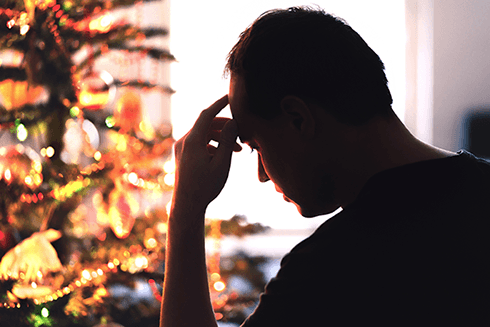 Social anxiety is one of the most common anxiety disorders, centering around situations where one might be judged and scrutinized by others.
Mild social anxiety might arise if someone has to speak in public or attend a job interview. It might also appear if someone has to speak to a cashier, go on a date, or meet new people.[3]
However, as with other types of anxiety disorders, social anxiety can have a significant impact on daily life if it becomes unmanaged.
For instance, people may feel fear of humiliation or rejection in everyday situations, like when eating in front of others or using a public restroom.[3]
Symptoms of social anxiety include:[3]
- Avoiding feared situations.
- Worrying about social situations weeks before they’re due to happen.
- Feeling overwhelming shyness in front of people.
- Mind blankness.
- Avoiding eye contact with others.
- Over-analyzing social situations after they’ve occurred.
- A racing heart, sweating, nausea, and other physical anxiety symptoms before and during feared social situations.
- Expecting the worst possible outcome from social situations.
- Assuming that others will make negative judgments.
Social anxiety disorder might also co-occur with other conditions. For example, a client might also experience physical health conditions, depression, obsessive-compulsive disorder (OCD), or body dysmorphic disorder, among others. Some people with social anxiety may also use drugs and alcohol to cope with their symptoms.[3]
Social anxiety can be managed at any time of the year with counseling or psychotherapy. At the end of this article, we’ll suggest a few therapeutic options that may be beneficial for your client. But first, let’s explore what you can do to help them manage their social anxiety during the festive period.
How to Help Clients Handle Social Anxiety at Holiday Events
Holiday anxiety and holiday stress can’t typically be managed by simply avoiding events or just powering through. To help a client protect their well-being at this time and begin to tackle symptoms of anxiety, you might need to encourage them to be a little bit brave and compassionate towards themselves.
Here are our recommendations for helping clients cope with social anxiety during Christmastime:
1. Help Them Notice Their Thoughts and Feelings
One of the first steps in managing social anxiety during holidays is to be more aware of the thoughts and feelings that drive their anxiety. This is central to the cognitive behavioral therapy (CBT) approach for anxiety disorders, which suggests that some thoughts and feelings keep anxiety going.[4]
For example, the following thoughts might perpetuate social anxiety:[4]
- That person looks like they’re frowning. They must not want to talk to me.
- I should be able to talk to all of these family members easily, like my brother does.
- My shyness is ruining this gathering. Why don’t I know how to speak to others normally?
- I feel embarrassed. Everyone must have noticed.
As we’ll explore next, challenging these types of thoughts is essential to managing social anxiety.[4] But before we do so, it’s also important that clients notice the types of feelings that might maintain social anxiety. For example, feelings of:
- Shame.
- Embarrassment.
- Fear of judgment.
- Shyness.
These feelings often fuel social anxiety. Supporting a client in noticing how these underlie their anxious thoughts and actions can be crucial for soothing their anxiety. For instance, they might indicate a strong drive to be “perfect” or fears of never being “good enough.” These feelings call for some self-compassion, which we’ll explore later.
2. Support Them in Challenging Cognitive Distortions
As you likely know, the thoughts that drive holiday anxiety and social anxiety are known as “cognitive distortions.” They are called this because they are faulty beliefs that many of us have about ourselves, other people, and the world around us. They’re irrational and inaccurate by nature and can cause a great deal of harm to our psyches, self-confidence, and anxiety levels.[4]
You can support a client in recognizing cognitive distortions like the ones we discussed in Tip #1 by highlighting how they’re:[4]
- Judging things in a “black and white” way.
- Assuming the thoughts of other people, as though they can mind-read.
- Imposing unrealistic expectations on themself.
- Imagining that they have control over the world, other people, and outcomes.
- Equating their feelings with reality.
- Overgeneralizing.
- Ignoring positive moments.
- Making things personal, as though other people’s bad mood or problems are their fault or centered around them.
Challenging cognitive distortions is an essential holiday stress management strategy. This might mean helping them:[4]
- Observe their thoughts as though they’re passing suggestions instead of reality.
- Highlight evidence that disproves them.
- Look for positives instead of focusing on the negative.
- Challenge their inner critic’s rules for life.
3. Counteract Their Avoidance Behaviors
Another thing about holiday stress and mental health is that avoidance almost always makes things worse. Avoidance might show up as a client’s belief that staying at home is safer than attending a party or that they need alcohol to cope with social anxiety.[5]
Though these tactics do often soothe anxiety in the moment, they ultimately keep anxiety going because they teach the mind that they’re not capable of overcoming it.
Therefore, another way you can help a client manage social anxiety during holiday events is to confront their fears. This might involve encouraging them to:[5]
- Attend events that they’re worried about
- Initiate conversations with other people
- Only drink soft drinks or stick to just one alcoholic drink
Counteracting avoidance behaviors can feel very intimidating. Therefore, in CBT, it’s often done gradually through small exposures. With this in mind, gradually challenging their avoidance might be helpful. For instance, you might get them to agree to stay at a party for just an hour or make a deal with them to initiate conversation with three people as a social warm-up.[5]
Crucially, once they’ve taken action that goes against their fearful thoughts, they should be supported in reflecting upon what happened. For example, they might think that they’re not able to initiate conversations at all, but, with your support in reflecting on the events, prove themselves wrong. This sort of evidence can be useful to come back to next time they feel socially anxious. Repeatedly challenging their anxiety’s predictions over time is key to diminishing its power.
4. Cultivate Their Self-Compassion
 As mentioned, feelings of shame and not being “good enough” are often at the root of social anxiety. While it can be extremely effective to challenge the thoughts and behaviors that perpetuate anxiety, it is also important to tend to the feelings underneath.
This is why another of our tips for managing social anxiety during the holidays is to help clients cultivate self-compassion. Self-care is not only important for managing stress levels but also for tending to the emotional wounds that are often at the root of anxiety.
Self-compassion might involve encouraging a client to:[6]
- Speak to themself kindly.
- Do things that they’re good at.
- Take breaks from socializing.
- Have baths, naps, and long walks on their own.
- Exercise, meditate, or cook.
- Speak to close friends or family members who are supportive and kind.
- Remind themself that nobody’s perfect and that they’re allowed to make mistakes.
And finally, it may also help to remind them that they’re not the only one who finds it hard to cope at Christmas. Often, social anxiety makes someone think that they’re the only one who’s “inept” or “weak”, and that everybody else is “competent” and “happy.” However, many people find it hard to cope during the holidays. In fact, research finds that:[6]
- 26% of people say Christmas makes their mental health worse.
- 15% of people say they feel overwhelmed at Christmas.
- 23% of parents say they feel low during the holidays.
- 36% of people with a mental health condition have self-harmed to cope at Christmastime.
While it’s not good news that so many people experience poor mental health during the holidays, realism is important for combatting social anxiety. It’s normal to find social events difficult at Christmas, so a client being compassionate and realistic towards themself can be essential during this time.
Find Additional Support for Social Anxiety During the Holidays With AMFM Healthcare
At AMFM Healthcare, we provide compassionate, evidence-based mental health treatment focused on meaningful, lasting results. Our outpatient treatment program, Mission Connection, has licensed therapists and mental health professionals that offer more than just holiday stress tips. They create a safe and confidential space in which clients can explore and challenge their feelings about social interactions.
What’s more, treatment is personalized to each client’s needs, symptoms, and goals. For instance, we might explore the roots of the issue through approaches like cognitive behavioral therapy (CBT), somatic therapy, acceptance and commitment therapy (ACT), or exposure therapy to help manage holiday anxiety.
If you’re supporting a client through social anxiety during the holidays but feel you’re hitting a dead end, contact us today at 844-690-0205. We can offer guidance and support for both your and your client’s needs during this time.
The holidays don’t need to be a time of increased stress and anxiety – we’re more than happy to help in whatever way we can.
References
- Koltuska-Haskin, B. (2023, December 29). What are “holiday blues” and how to deal with them? Psychology Today. https://www.psychologytoday.com/gb/blog/how-my-brain-works/202312/what-are-holiday-blues-and-how-to-deal-with-them
- Greening, N. (2025, December 20). Feeling the festive fear? how to deal with social anxiety at christmas and new year. Social Anxiety Alliance UK. https://socialanxietyalliance.org.uk/how-to-deal-with-social-anxiety-at-christmas-and-new-year/
- National Institute of Mental Health. (2022). Social anxiety disorder: what you need to know. https://www.nimh.nih.gov/health/publications/social-anxiety-disorder-more-than-just-shyness
- Ackerman, C. (2017, September 29). Cognitive distortions: when your brain lies to you. Positive Psychology. https://positivepsychology.com/cognitive-distortions/
- Cassiday, K. (2025, November 10). Managing holiday stress for the stressed. Adaa.Org. https://adaa.org/learn-from-us/from-the-experts/blog-posts/consumer/managing-holiday-stress-stressed
- Gunn, L. (2024). Christmas anxiety and what you can do about it. Nuffield Health. https://www.nuffieldhealth.com/article/christmas-anxiety-and-what-you-can-do-about-it